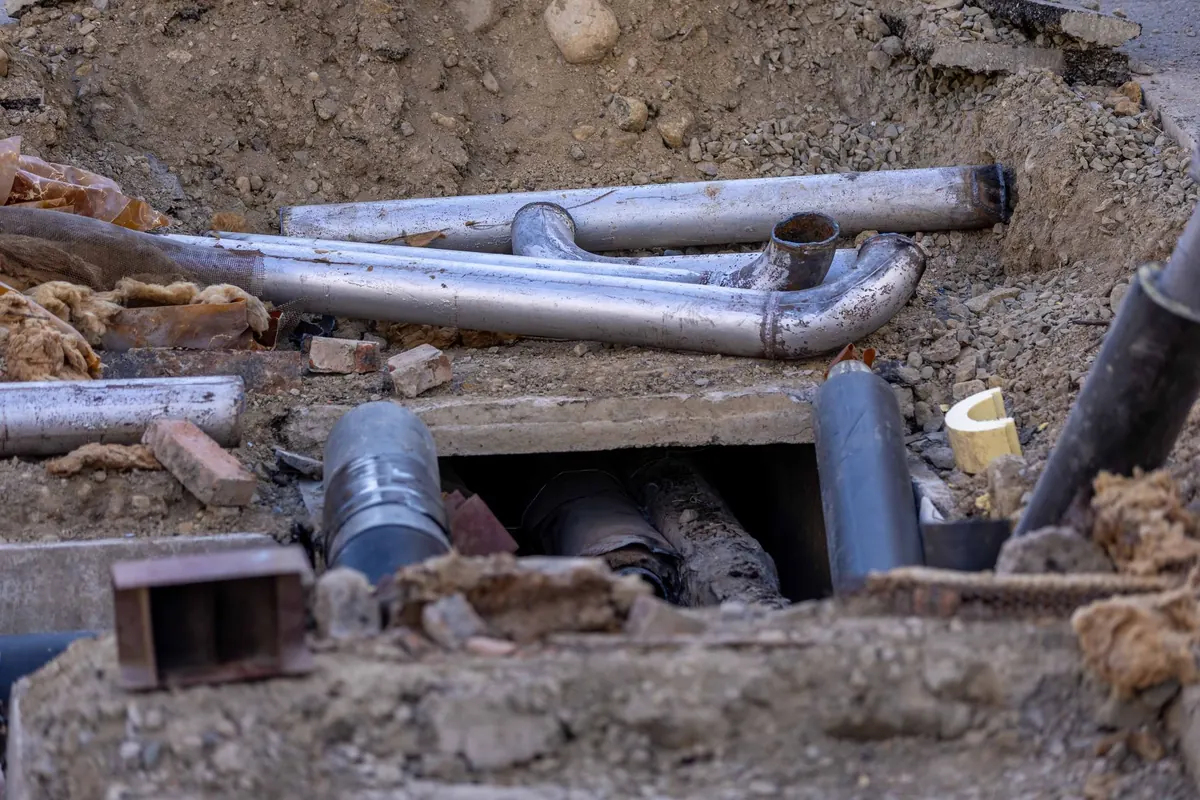
The plot looked perfect in the agent's photos. Then you walk it in February, find a manhole cover under the brambles, and realise the nearest water main is on the far side of the lane. Utility connections are the least glamorous part of a self-build and the easiest thing to underestimate. They are also almost entirely predictable, provided you price them before the foundations go in rather than after. Below is how to build a realistic budget for water, power, drainage and broadband, and the questions worth asking early.
Before you ring a single utility company, establish what is already on site and what rights you have to cross other land. A utility search, arranged through your solicitor, will show which networks sit near the plot, but it rarely tells the whole story. Walk the boundaries and look for inspection covers, poles, overhead lines, meter boxes and lengths of duct poking out of the ground. A demolished cottage may have left you an existing water connection and a live electricity supply, which changes the budget completely.
Talk to the neighbours as well. Someone within a few hundred metres has almost certainly been through the same process with the same network operators, and their experience will tell you more about lead times and practical difficulties than any brochure. Ask the vendor for any previous connection quotes or correspondence. And check your title: a plot with a documented right to lay a service pipe across a neighbour's field is a very different proposition from one without.
If a main is nearby, you apply to the water company for your area — the regional water company in England and Wales, Scottish Water in Scotland, NI Water in Northern Ireland. They will assess whether a straightforward connection is possible or whether a new main has to be laid to reach you. Charges generally reflect the work involved: the distance from the main, the surface being dug through, whether a road crossing is needed, and whether traffic management or a closure is required. A connection in a soft verge is a very different job from one under a busy road.
If you are some distance from the main, ask about self-lay or a new main requisition, where an accredited contractor does part of the work to the company's specification. It can be cheaper and quicker, though you take on more of the risk. Do not forget the temporary supply: a standpipe and meter for the build itself, with hire charges and water usage to pay for.
Where there is no main within sensible reach, a borehole with treatment — filtration, UV, a storage tank and a pump — is the usual answer. The water still has to be wholesome and the abstraction rules vary by nation, so check with the environmental regulator for your part of the UK before you drill. Take professional advice on water quality testing, and budget for ongoing servicing rather than treating the borehole as a one-off cost.
Apply to the distribution network operator (DNO) for the area, or consider an independent network operator if the site is complex. The quote will hinge on three things: the capacity you ask for, the distance from the nearest suitable point on the network, and whether a new transformer or substation is needed. Ask for more capacity than you think you need. A heat pump, an electric vehicle charger, an induction hob and a workshop all pull power, and upgrading later costs far more than sizing properly now. Where a three-phase supply is available, it is often worth having.
Ask which parts of the work can be carried out by an accredited independent contractor rather than the network operator. Contestable work — usually the trenching and ducting — can be done within your own groundworks programme and priced competitively. Note that if a substation has to sit on your land, you may be asked to grant an easement or lease, and that has legal costs attached.
For the build itself, you will need a temporary supply, whether that is a builder's meter or a generator. Generators mean hire charges, fuel and noise, so factor them in if the permanent supply will not be ready in time. And remember the internal side: the meter box position, the cable run from the boundary to the house, and the consumer unit all sit in your budget, not the network operator's.
Where a public sewer is within reach, you generally have a right to connect, subject to the sewerage undertaker's requirements, and the cost is driven by depth, distance and the condition of the existing sewer. If you are building close to or over a public sewer, expect to need a build-over agreement, which takes time and money to obtain.
Where no sewer is reachable, you will be looking at a treatment plant and drainage field, or a septic tank, with a discharge consent if anything goes to a watercourse. The system you can use depends on the ground, so commission a percolation test or ground investigation early. That single piece of information can swing the drainage budget dramatically, and it is far cheaper to discover the answer before you design the garden.
Surface water is dealt with separately from foul. Soakaways, attenuation crates, or a connection to a surface water sewer are the usual options, and planning conditions often push you towards sustainable drainage. Do not let this become an afterthought — a soakaway that fails is an expensive hole in a finished driveway.
Broadband is the cheapest of the four if you plan it. Ask the network provider to register the plot as a new site early, and lay a duct with a draw rope during your groundworks. A short length of duct costs very little; retrofitting one under a finished drive costs a great deal. If fibre is not yet available, a 4G or 5G router will often carry you through, but treat it as temporary.
Gas, if there is a main nearby, follows the same pattern as water. If there is not, your heating decision is made for you: an air source heat pump, LPG or oil, with tank siting and bunding to consider. While the trenches are open, it is worth adding ducting for gate motors, garden lighting and an EV charger, even if you fit the equipment later.
The trick with utilities is to treat them as a design exercise rather than a set of bills that arrive later. Get written quotes, compare them line by line, and ask what is excluded. Keep every quote and approval in one place, because when the build is underway you will not want to hunt through emails for a connection reference.
Above all, keep a genuine contingency. Utility work is where ground conditions, access problems and network constraints have a habit of turning a tidy figure into a larger one. If you are dealing with easements, boreholes, discharge consents or build-over agreements, take advice from a solicitor or a surveyor who has handled self-build plots before — the fee is small compared with the cost of getting it wrong.
Photo: Sergei Starostin / Pexels

Turning garden land into a building plot hinges on planning policy, access, services and neighbour objections — most...

Landlocked plots have no automatic right of access. Here is how easements, rights of way, prescriptive claims and...

A quarter-by-quarter allotment plan covering clearing, digging, sowing, watering and winter repairs, so each...

Find the right plot for your project.
